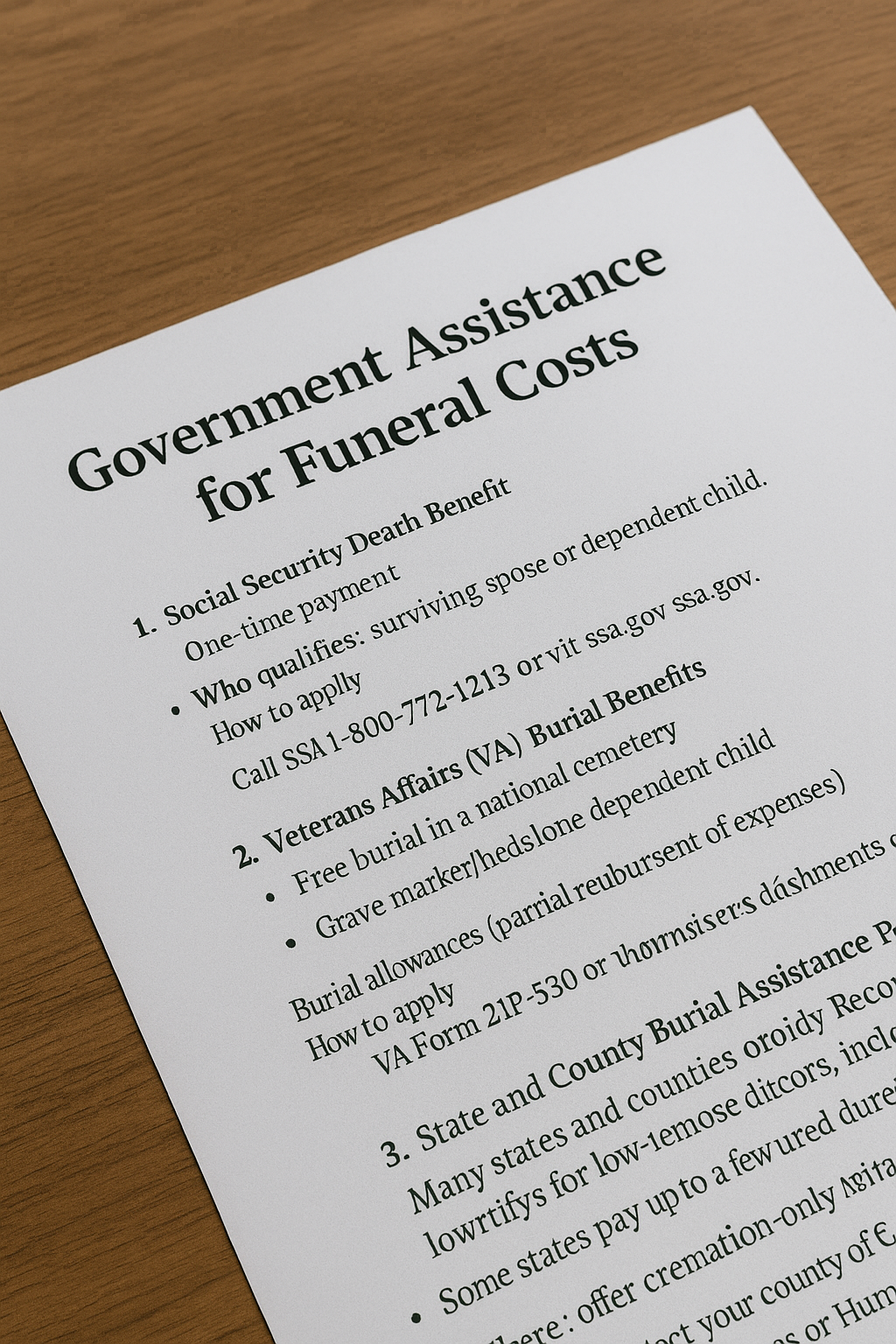
Government Assistance for Funeral Costs: What Help Is Available
 Cameron Williamson
Government Assistance for Funeral Costs: What Help Is Available
Funeral expenses can add unexpected financial stress during an already difficult time. The average cost for a U.S. funeral (including service, casket or urn, and burial) often ranges between $7,000 and $12,000, and does not include cemetery fees, flowers, or receptions. Fortunately, there are several government programs and public resources designed to help ease the burden for qualifying families. If you’re wondering what kind of help might be available, here’s a breakdown of key federal and state programs, how to apply, and what to expect.
What You’ll Find in This Guide
Federal benefits & programs
VA (Veterans Affairs) assistance
FEMA and disaster-related assistance
State & local programs
Tips & eligibility criteria
1. Social Security Lump-Sum Death Benefit
What it is: A one-time payment of $255 to help certain survivors with funeral costs. Social Security+1
Who qualifies: A surviving spouse who was living with the deceased at death or certain children who were dependent on the deceased. Social Security
How to apply: Call the SSA at 1-800-772-1213 (TTY 1-800-325-0778) or visit SSA.gov to submit Form SSA-8 (Lump-Sum Death Payment). Social Security+1
2. Veterans Affairs (VA) Burial Benefits
If your loved one was a U.S. veteran, the VA offers several forms of assistance.
What’s offered:
Free burial in a national VA cemetery (if eligible) Veterans Affairs+1
Grave marker or headstone, a U.S. flag for burial, and possibly a Presidential Memorial Certificate Veterans Affairs+1
Burial allowances to help cover some funeral and transportation costs. For service-connected deaths, there can be reimbursement up to $2,000; for non-service-connected deaths the allowance is smaller (e.g. about $978 as of Oct. 1, 2024) depending on circumstances. Benefits+2Veterans Affairs+2
Who qualifies: Veterans discharged under conditions other than dishonorable; depending on service history, spouses, minor children, and dependent adult children in some cases. Veterans Affairs+1
How to apply: Submit VA Form 21P-530EZ for the burial allowance and/or transportation allowance. Visit the VA’s “Veterans Burial Allowance and Transportation Benefits” page. Veterans Affairs+1
3. FEMA COVID-19 Funeral Assistance & Disaster-Related Aid
What it offers: Reimbursement up to $9,000 per funeral for eligible COVID-19-related deaths. Includes costs like funeral services, cremation or burial, death certificates, transportation, etc. FEMA
Who qualifies: U.S. citizens, non-citizen nationals, or qualified non-citizens; the death must have occurred in the U.S. (or territories); death must have COVID-19 listed as a cause or contributing cause; you must have incurred eligible funeral expenses after Jan. 20, 2020. FEMA
How to apply: Call FEMA at 1-844-684-6333 or apply through DisasterAssistance.gov. Gather documents like death certificate, funeral home contract/invoices, receipts. FEMA+1
Important deadline note: There is a deadline to apply for this assistance; many states and FEMA have noted September 30, 2025, as a deadline to apply in some cases. National Funeral Directors Association
4. State, County, and Local Burial Assistance Programs
Beyond federal aid, many states, counties, and local jurisdictions offer assistance to low-income families or individuals with few resources. These may include:
Direct payment or voucher for cremation or burial
Transportation of remains
Modest caskets or urns
Support for basic cemetery or plot fees
How to access: Contact your local Department of Social Services, Human Services Office, or County Department of Health. Eligibility and benefit amounts vary widely by location; some programs require proof of income or that no other family members can provide funds.
5. Medicaid Funeral Assistance
In many states, Medicaid provides limited funeral or burial assistance for those who were eligible for Medicaid at time of death. Some states allow “irrevocable funeral trusts” or “spend-down” arrangements to set aside funds in advance.
How to check: Reach out to your state’s Medicaid office or ask your funeral provider if there’s a Medicaid burial assistance program in your area.
6. Additional Sources of Help: Crime Victims & Indigent Programs
Crime Victims Compensation Funds: If death was caused by a homicide or violent crime, many states offer financial assistance to cover funeral and burial costs. Check with your state’s Victim Services or Compensation Board.
Indigent Burial / Pauper Burial Programs: For individuals with no known family or assets, local governments often provide a basic burial or cremation free of cost. Hospitals, coroners, or county human services usually make these arrangements.
Tribal or Native Programs: Many tribes provide funeral assistance for enrolled members; reach out to your tribe’s social services or elder services.
Meta Information for SEO
Title: Government Funeral Assistance Programs: How to Get Help with Funeral Costs
Meta Description: “Learn about government funeral assistance you may qualify for—VA benefits, FEMA COVID-19 aid, Social Security death payments, state & local help.”
Final Thoughts
Losing someone is hard enough without having to worry about how to pay for a funeral. These programs exist to support families during such times. Even if you qualify for just one, it can make a difference. If you're not sure where to start, consider talking to your funeral home, a local social services office, or directly calling the agency.
Also, if you’re planning an obituary or memorial, tools like RemembrLink Obituary Writer can help you organize service details, write a thoughtful tribute, and share it with ease.
Search
Latest Blogs